

The Differences Between Sports Broadcasting and Journalism in the UK & US: Featuring Gary Neville as an example...
It is normal for a broadcaster to be thrown out of a sporting event in the UK; but in the US not so much. Thanks to Gary Neville, I can write something now... been wanting to write for awhile now.

Note and disclaimer from the author:
Before I even can begin this article—I would like to say I researched what I could. I did not do an in-depth research regarding journalism law in both the US and the UK. There are some similarities and some differences. Which, I will be pointing out below. Journalism law is different in both countries.
There is really no set sports journalism laws—due to the fact they fall under journalism law as a whole in both rightful countries. I can say that about journalism laws regarding tabloids too (which seem to follow journalism laws loosely—or not at all—more research to come on that). I am doing another article regarding that in a month or so.
I research what I could to the best of my ability. I am being open about this to everyone because of the changing world we live in regarding journalism and journalists. I also want to put this here in the front of the article so, I don’t get into any trouble. I will do the same for the other article I am writing.
I just want some transparency between me the starting out freelance journalist and my audience. I feel like it is appropriate due to the changing world of journalism and the world we live in—regarding the growing amount of people who are losing trust in the media and the news—sadly.
I remember being in a heated discussion in a WhatsApp group. It had three other journalists in it: two from the United States (a full time one and freelance writer aka me) and one from the United Kingdom (a full time journalist). Not sure how many conversations we had (which were many) involving how journalism works—on the UK side of things, plus what it was like being journalists in the US. Us Americans trying to understand the world of journalism in England and the UK. While also, sharing our side of things what journalism is like over here on the US side of the pond.
Sometimes it felt like there was no regard for how journalism worked in the US. Sometimes it was just conversations on how it worked in both countries. When the conversations went the way of how journalism worked on both sides of the pond it was beautiful. Lot of cultural ways of how journalism worked in it’s respective countries was making me feel like I was working at Disney again and in Epcot sharing what it was like to live in the US with others from around the world again. If the conversation ever went south—I knew and the other American knew we weren’t getting a word in—why bother. Wasn’t worth any of our energies.
Personally, wanting to get into the world of football/soccer journalism I find myself in both worlds. I sometimes get so involve in it—I forget what time zone I am living and working in. I even have started using British slang more than American slang.1 I will sometimes sneak ‘u’’s into words like color/colour, favorite/favourite, neighbor/neighbour, and etc. I believe now, I have a little British accent that will appear at times too when I speak. I feel like I am living and working in both countries—however, I just live in one and cannot afford to leave it yet—one day is the goal to travel between the two once I am more established in my career.
With having my “work/life” balance feeling like it is trapped between these two countries—I have been following both of the journalism laws in each country. I am not fully brushed up on the UK, but learning on the go. I have been listening and watching what I can of pundits in both countries for football. Usually those on Sky Sports, BBC Sports, NBC Sports, and CBS Sports2. Just to get an idea of what is what.
It’s interesting to see how things are handled in the UK and think about what would happen if they were handled that way if it happened in the US. One of those moments is when Gary Neville got kicked out of working a Nottingham Forest Football Club match because of his comments he made about Forest’s owner on Twitter/X3. In the UK no one really batted an eye; but however, in the US that would have made national news. A big reaction from anyone who is anyone in the media, politician, or celebrity—and even everyday people on social media. It inspired to write this article at the end of the 2024/25 season. I have been wanting to explore the differences for awhile now.
It is different due to fact that Gary Neville himself is not a journalist—he is a pundit and commentator. He played the sport for Manchester United Football Club and England between the years of 1992 - 2011. He also had a short managerial career between the years of 2012-2016. Neville would be consider here in America as a color commentator—that is where they have experience in the sport their commentating on. I do not have any examples that come on top of my head to compare him with on American television. I don’t think Tom Brady or Tony Romo coached before they did broadcasting work. So, this is a hard one to draw a comparison to help explain who he is for the American side of the audience.
The point is Neville can not break breaking news about anything in sports in the UK—I believe they treat this the same in the US coverage of football/soccer on both NBC and CBS. I am not really sure—had to Google both Kate Scott (Adbo) and Rebecca Lowe to see if they were both journalists—they have worked with serious news platforms the likes of CNN, Sky Sports, and BBC. I am not sure if that means they were also breaking news on their like they do when it comes to breaking news on CBS and NBC for the sports coverage. Again, I did not really research this fully—and I am not sure if it accessible for me to do so. I have a feeling it is not due to it is apart of their contracts, which rightfully is kept private.
I am more focusing on freelance journalism right now—were I just write. Broadcasting journalism is a whole other different thing all together. I am not that familiar with it. I like broadcasting loved it growing up being amazed in how it all works, then in college becoming a journalist I had to learn the ropes of how to work a camera, read off of a teleprompter, and how both television and radio works. I loved that stuff—and just want to stick to the world of writing and radio. Maybe some television one of these days—however this should be a complete other article all together. In short I am saying I have no idea how network national television works in the US and UK when it comes down to the world of Gary Neville and what he does with it. This is mainly me going off of speculation and my knowledge best to my research.4
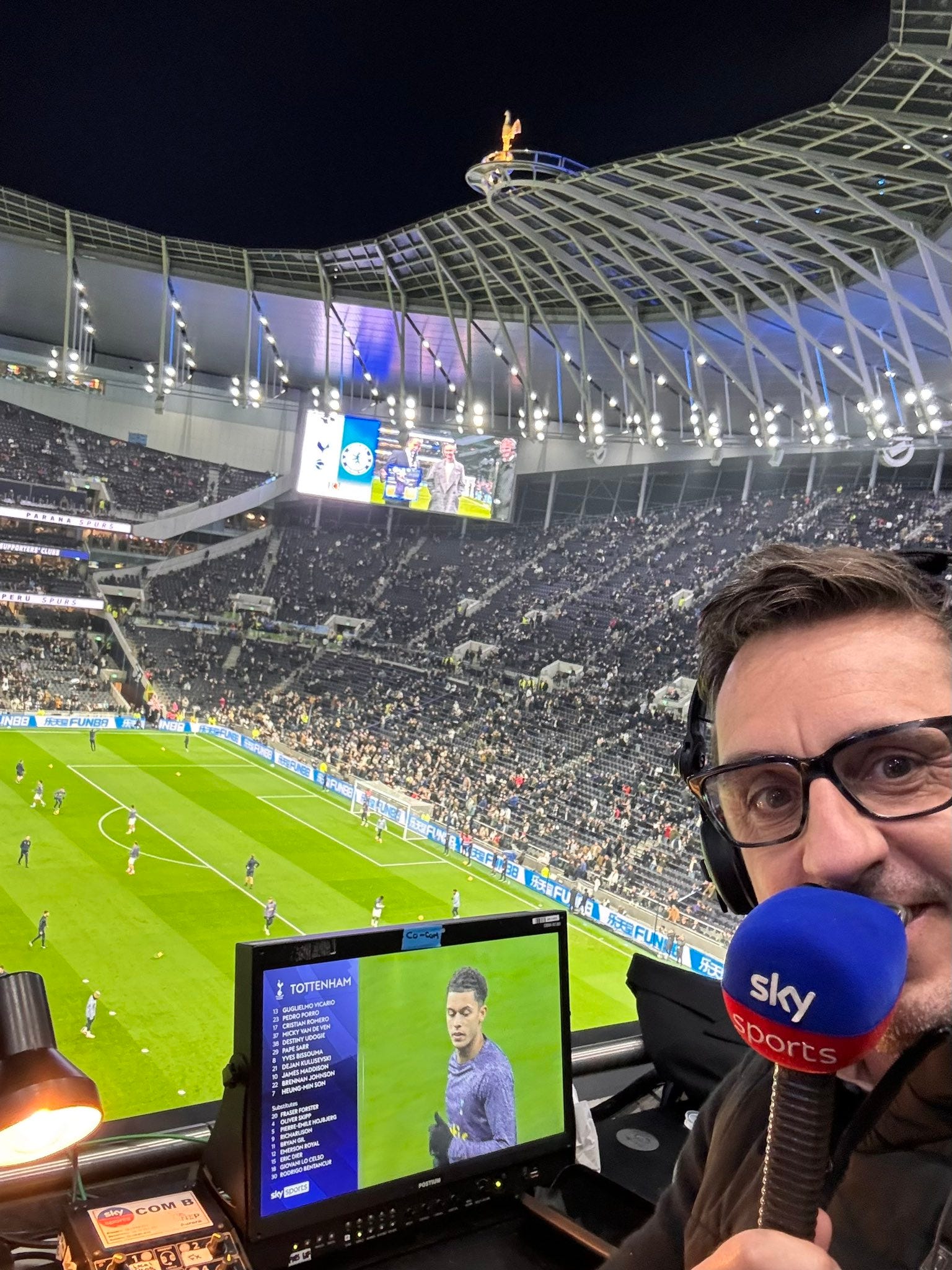
On May 23rd broadcaster Gary Neville got banned from coming in with Sky Sports to do coverage on the final day of the 2024-2025 season of the Premier League. He was supposed to be at the Nottingham Forest Football Club ground for the May 25th match. However, the Nottingham Forest owner banned him. This was due to comments that Neville had made about him. His one of his fellow co-host Jamie Carragher got in contact with the owner of Nottingham Forest to see if he could fix it. Within doing this Carragher found himself also banned too.
There could be multiple reasons why Neville was banned from the match. First one was a reaction to the time that Nottingham Forest lost to Everton Football Club in the 2023-2024 season. The Forest owner; Evangelos Markinakis had a reaction to the loss, he released a statement via the club’s social media calling out the refereeing of their 2-0 lost to Everton.5
The second thing that was probably the reason why he was banned from the Nottingham Forest ground was this tweet:
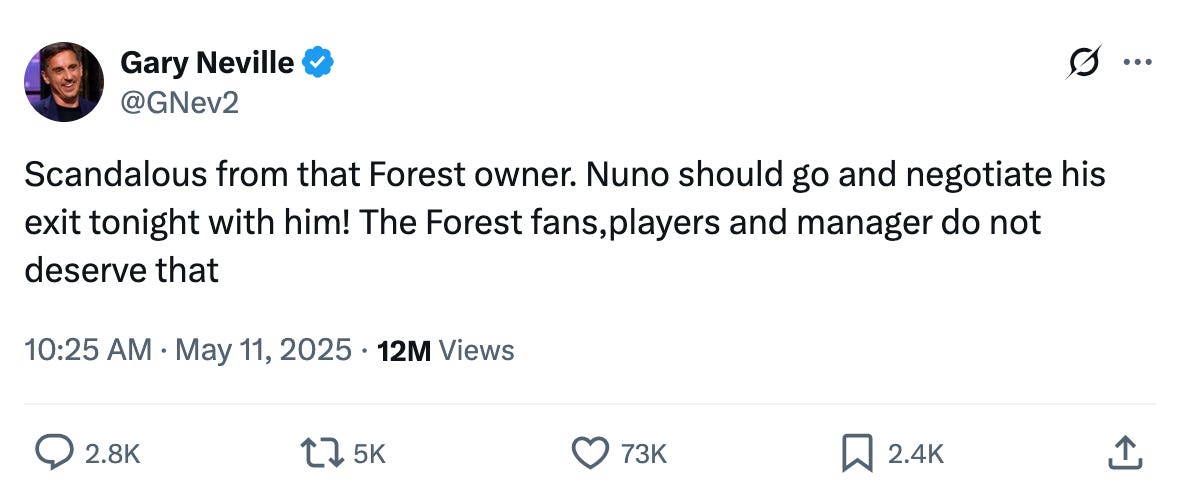
I believe this was regarding after the match (on the same date) where Markinakis stomped on the field towards what I believe was injured Taiwo Awoniyi and was angry. The manager at the time Nuno Espírito Santo got to Markinakis in time before he could get to the injured player [Awoniyi]. I am not sure what would happen if Santo did not step in. (I am also afraid to think about it too). I saw this live on television to at the time. I was panicked for Santos at the time too—and the player—like I said if Santos did not get in the way. If you have seen a picture of the Nottingham Forest owner—he is someone who you do not want to get on the bad side of (well, has the looks of it)—but what I’ve seen of his reactions to when Forest losses, I stand by the comment of someone I never met.
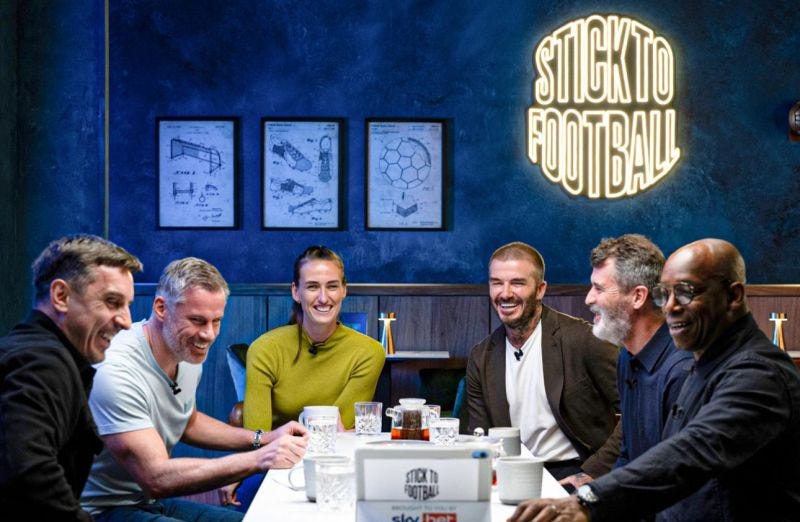
In my research for this article too—I did come across mentions of Markinakis also having reactions about comments made about Forest and him on Sky Sports. I am not sure which pundit it is directed to—we do not have access here to Sky Sports in the US. So, the comments could be from any of the pundits on air, in the commentary, or on Neville’s podcast the Overlap or on the Overlap production company label—Stick to Football podcast, and maybe it’s US sister podcast called “It’s Called Soccer”. I do not have the time to sort through all these to find examples.
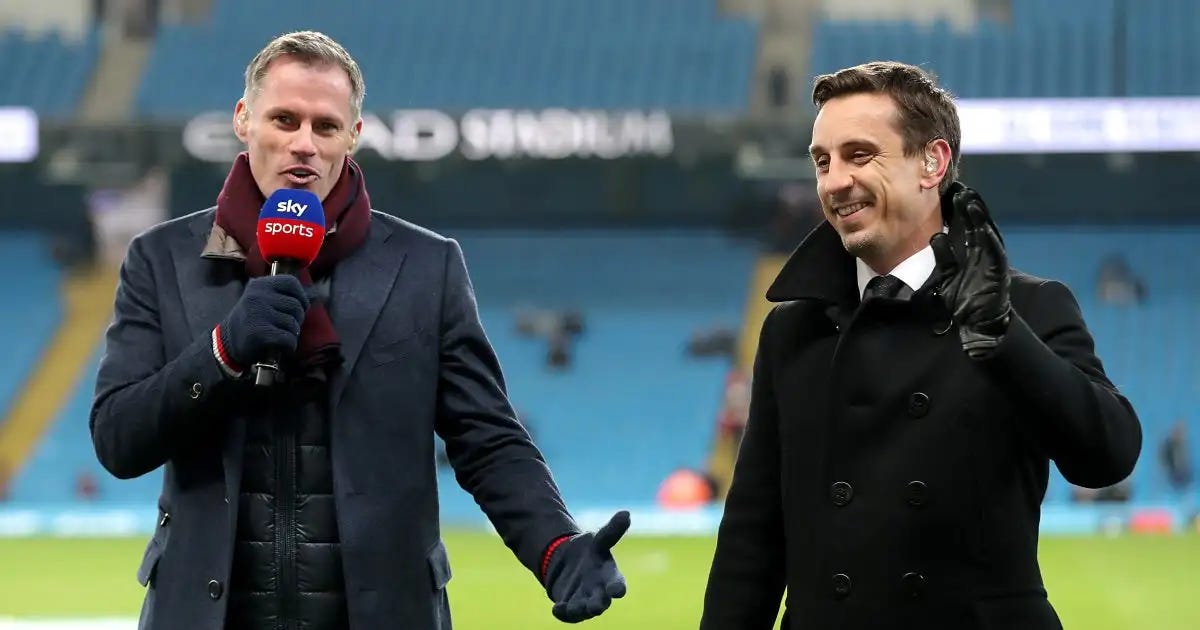
The broadcasting of the UK structured differently than the US. I did not do much of a deep dive into it—but, I notice these little differences when watching some videos online or talking to follow Everton supporters who live there.
Unlike the US the UK has this program called Ofcom where the public can be the ones who help making the calls on things they see on television and hear on the radio—and maybe also podcasts too. The public can call out the media if they are not balanced or if something was offensive to the nation. Also, to call out the media if they weren’t correct in the information they addressed in a news story.
Certain news organizations like the BBC have certain protocols on how to release the news; and who should do it—I think the BBC is the only one that does this. It probably has to do with the BBC being close knit with the Royal Family. Either way, without or with the BBC the Royal Family themselves have their own protocol in breaking news about themselves to the world—the example I am thinking of when Queen Elizabeth II died. It was interesting listening to BBC Radio 1 that day. They played less of the top forty music and started playing more calmer music until they got the go ahead to break the news. Before the news “God Save the Queen” played before the announcement was made on Radio 1—which the BBC World Service took over all of the BBC programing on all platforms of broadcasting to announce the late royal’s death.
In sports media, they have a protocol of some kind to regarding the football clubs themselves in the Premier League. (I am sure there is something like this too in the US). There has to be some kind of protocol regarding the FA (Football Association) in the UK too when it comes to how clubs are ran and how to break news to the public about certain things—trading and signing a player kind of thing, hiring and firing managers, and etc.
UK seems to have more of a click-bait kind of attitude (well, more Sky Sports than the BBC) when it comes to pundits. It is more opinion based than factual and stats based. It is refreshing in a way—but, at the same time I would like to have both. I am probably saying this because I am annoyed with the pundits we have here in the US when it comes to the US sports (however, the Milwaukee Brewers Live broadcasters and their program is an exception!6). Also, with the UK they’re more what I like to see when I look for my football/soccer coverage. I feel like that is what they are trying to with the NBC and CBS coverage of football/soccer over here.
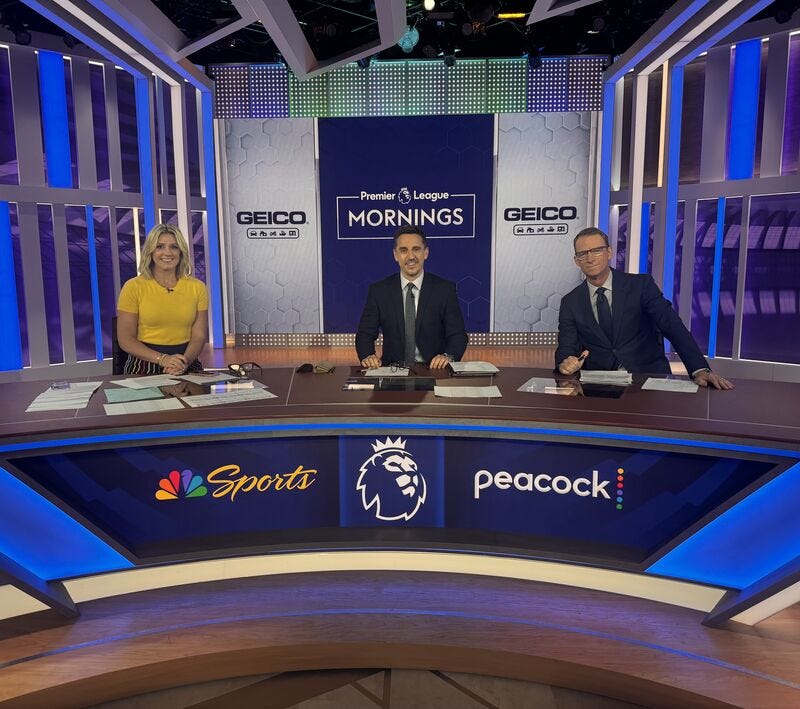
In the US when it comes to sports broadcasting—it is a complete different animal. There are many professional sports leagues here in the US (with two also based in Canada—NHL and MLB) were each of these leagues have their own rules about broadcasting. However, I feel like there is a agreed upon that each of the professional leagues work with their respective broadcaster(s) in how the leagues and sports are shown.
The Freedom of Press in the First Amendment in the US Constitution that what is followed within all of the press who release news daily—and sports and entertainment news too. It’s for holding those in power accountable, allows the government not to tell the press what they can publish (unlike the UK where they have to adhere to what they can publish about the Royal Family—well, from what I gathered recently in recent times, from experiencing listening to a lot of news from the BBC7).
There is a limitations to the freedom—no swearing, no being sexist, raciest, and etc—in all media. There is a ten second delay encase let say someone does decide to streak across a sporting field naked during a sporting event (this has happened before—clothed or naked). Making sure there is a balanced views on public issues (this is more for politics—and also goes for sports too—more balanced view on the broadcast of both teams during a sporting event with teams playing against one another). All press needs to follow the FFC (Federal Communications Commission) regulations that are rules to follow (the no swearing, no nakedness, and etc ones) and dealing with ownership limitations (not sure what this implies… as in ownership of the NFL being able to broadcast to the nation—is a guess of mine).
If a sports team banned Gary Neville from broadcasting in the US it would make big news coverage. I am not sure how much of the comments about an owner of a sports team would affect if he could broadcast for the NFL, MLB, or NBA national coverage or not. I think it would just be brushed under the rug and everyone would act like professional adults about it. I doubt and not sure if Neville would have time to talk to both of the owners of the home and away teams that would be participating in the event itself. The fact he would be mainly and only doing punditry work in the studio and not the commentary kind of stuff—if he were to do both together: it would be Gary Neville and Al Michaels as a tag team. (Which I now want to see…).
One thing that both the US and UK media, broadcasting, and journalism can agree on is no libeling or slandering of individuals or organizations. Each country those who feel like they have been slandered or libeled can sue the news organization if they feel they have been wronged. Also, both countries have protections for wide range of media: broadcasting, print, and social media.
In the US we really don’t have an Ofcom kind of thing like the UK does. I believe, there can be space for individuals to call out the press in the US. It would take a lot because it is not organized like Ofcom. An individual would go straight to the news outlet that released that news story and would straight out sue them if apical. I don’t know how that works in the UK and Ofcom—as in does the individual goes through Ofcom or sues the organization directly if apical. I did not get there in my research, felt like it was not relevant to this article.
I am unsure how this article turned out. I think I have accomplished what I wanted to. Try to explain to the best of my ability the differences between sports press, broadcasting press, and news press in the US and the UK. I could have dived much deeper than I did. But overall, I did not want to shift the focus off of Gary Neville getting kicked out of the Nottingham Forest stadium.
In the UK no one bat an eye because that is something they are used to over there. It’s more common then we probably think over here in the US across the pond. Over here in the US it is something unheard of. Which did surprise most of us Americans who follow football/soccer. Which also, finally inspired an article like this.
I forgot the word snowplow (US word for it) for their term gritter (UK word for it) when seeing one drive by me for the first time a week ago. It’s okay when I am by myself—but when I am around my friends and family here in Wisconsin, I have to start translating myself. I am still speaking English—but British English; not American English. Gotten me in trouble a few times.
I feel like the CBS Sports pundits kind of dealing with what I am somewhat dealing with too. They stick to the UK journalism laws—but, also adhere to the US laws too (what they’re familiar with (the UK laws))—just like me.
This was not in breach of the Premier League’s rules where a club could kick out someone from the media. The clubs themselves get to decide who can do media coverage of a match.
My goal is to be as transparent as possible with you all. I am not worried about getting sued by anyone or getting into big trouble with the UK or US governments in particular.
There are bigger fish to fry than me talking about network broadcasting nationally in the US and the UK. I am doing this to protect me from misunderstanding from those who read this—who do work in these networks themselves—if they do read these. Please add in any correction if you do.
This is all opinion and no right or wrong.
It was during our first ToffeeFest in Chicago. It was the Sunday match where it was 2-0 win to Everton. There was statement released by Nottingham Forest by their owner Evangelos Markinakis that out within two or five minutes after the final whistle blew. Markinakis was mad that the refereeing was awful; there was a belief that it was skewed our [Everton’s] way to win the match. (This is from a rough memory.)
I remember everyone becoming very quiet so we could listen to Rebecca Lowe read out the statement live on television. Or if it was not that—it was the person who announced it to the whole pub, who read out the statement themselves.
It’s more of a local broadcast compared to a national one—so, I think that is why it is like what I mentioned. Maybe more relaxed in a way too.
I feel like it is more BBC based. I cannot speak for the other news outlets in the UK. I have seen opinions about this spread throughout on social media platforms. There has been views that BBC is tiptoeing around the Royal Family and caters to them.